



Here is one small, unexpected piece of news: I now have my first package on PyPI! It’s called fcompdata, and let me tell you a little bit about it.
When I test my functions in R, I usually use the M1, M3, and tourism competition datasets because they are diverse enough, containing seasonal, non-seasonal, trended, and non-trended time series of different frequencies (yearly, quarterly, monthly). The total number of these series is 5,315, which is large enough but not too heavy for my PC. So, when I run something on those datasets, it becomes like a stress test for the forecasting approach, and I can see where it fails and how it can be improved. I consider this type of test a toy experiment — something to do before applying anything to real-world data.
In R, there are the Mcomp and Tcomp packages that contain these datasets, and I like how they are organised. You can do something like this:
series <- Mcomp::M3[[2568]]
ourModel <- adam(series$x)
ourForecast <- forecast(model, h=series$h)
ourError <- series$xx - ourForecast$mean
Each series from the dataset contains all the necessary attributes to run the experiment without trouble. This is easy and straightforward. Plus, I don’t need to download or organise any data — I just use the installed package.
When I started vibe coding in Python, I realised that I missed this functionality. So, with the help of Claude AI, I created a Python script to download the data from the Monash repository and organise it the way I liked. But then I realised two things, which motivated me to package it:
- I needed to drag this script with me to every project I worked on. It would be much easier to just run "pip install fcompdata" and forget about everything else.
- Some series in the Monash repository differ from those in the R package.
Wait, what?! Really?
Yes. The difference is tiny — it’s a matter of rounding. For example, series N350 from the M1 competition data (T169 from the quarterly data subset) has three digits in the R package and only two if downloaded from the Monash repository (Zenodo website).
Who cares?! It's just one digit difference, right?
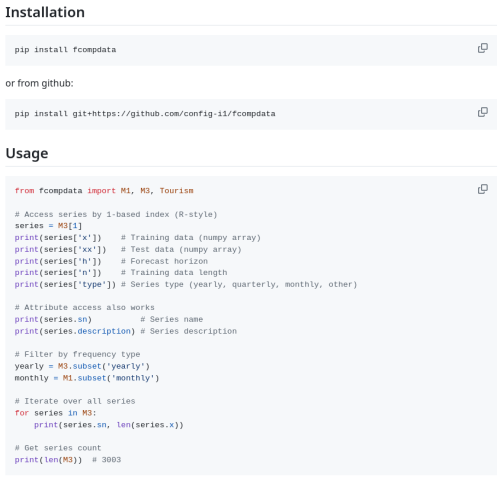
Well, if you want to reproduce results across different languages, this tiny difference might become your nightmare. So, I care (and probably nobody else in the world), and I decided to create a proper Python package. You can now do this in Python and relax:
pip install fcompdata

from fcompdata import M1, M3, Tourism
series = M3[2568]
The "series" object is now an instance of the MCompSeries class that has the same attributes as in R: series.x, series.h, series.xx, etc.
As simple as that!
One more thing: I’ve added support for the M4 competition data, which — when imported — will be downloaded and formatted properly. The dataset is large (100k time series), and I personally don’t like it. I even wrote a post about it back in 2020. But if I want the package to be useful to a wider audience, I shouldn’t impose my personal preferences — you should decide for yourselves whether to use it or not.
P.S. Submitting to PyPI gave me a good understanding of the submission process for Python and why it can be such a mess. My package was published just a few seconds after submission — nobody looked at it, nobody ran any tests. CRAN does a variety of checks to ensure you don’t submit garbage. PyPI doesn’t care. So, I’ve gained more respect for CRAN after submitting this package to PyPI.