



Teaching statistics as a flipped classroom with the help of AI? You heard that right! That’s exactly what I tried this year – and here are the results.
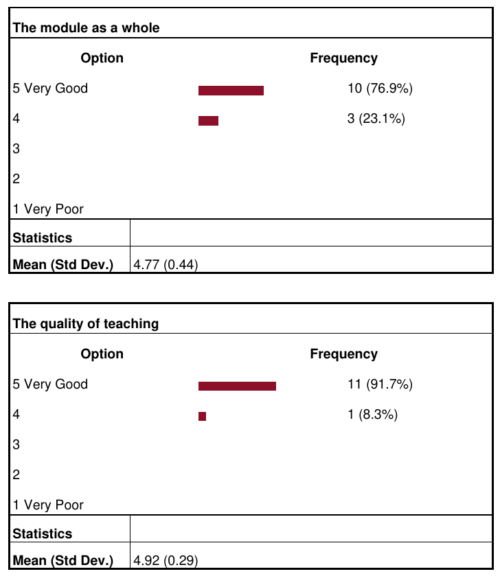
Attached to this post is the student evaluation score for the module. Yes, the number of responses is quite low (only 50% of the cohort), but it should still give a sense of how students perceived Statistics and Descriptive Analytics. Of course, this reflects only their impression – coursework submissions are yet to come – but it’s still an encouraging sign that some things worked well.
I’ve taught this module since 2018, first with Dave Worthington and later with Alisa Yusupova. Normally, I focused on the second half, covering regression through lectures and workshops. But this year, I took on the full module and realised I didn’t want to teach probability theory and statistics in the traditional way – long monologues in lectures followed by awkward silence in workshops. That format, I believe, no longer works. After all, students can always ask their favourite LLM to explain concepts they don’t understand. And some don’t even do that – they just ask to solve problems without understanding them. So, what can be done in this brave new world?
I don’t yet have a definitive answer – only the results of an experiment.
Lectures. This year, I used Google Notebook ML to prepare lecture materials. I provided my existing notes, slides, and relevant texts, then asked it to produce podcasts on specific topics. This took more time than expected, as I had to review the generated content, adjust prompts, and refine focus areas, listening to the podcasts over and over again. Once ready, I uploaded the materials on Moodle and asked students to listen beforehand. In class, we skipped formal lectures and instead had whiteboard & marker discussions. I asked questions, showed derivations, and encouraged debate. With a class of 26 students, it was possible to create much more interaction than in previous years.
Workshops. We still had problem-solving sessions, but I allowed (actually encouraged) students to use LLMs to solve tasks and explain why the solutions were correct. The aim was to emphasise reasoning and assumptions over simply obtaining the right number. This worked with mixed success, and I still need to think how it can be improved further.
Did it work overall?
I’m not entirely sure. Not all students engaged with the materials in advance, but those who did seemed to benefit and appreciated the approach. What I do know is that the “two-hour monologue while everyone tries not to fall asleep” format does not work any more. For universities, and for the (very!) expensive UK education, to remain relevant, we must innovate and rethink how we teach.
What would you change if you were teaching a technical subject at university in the era of AI? I’d love to hear your ideas.