
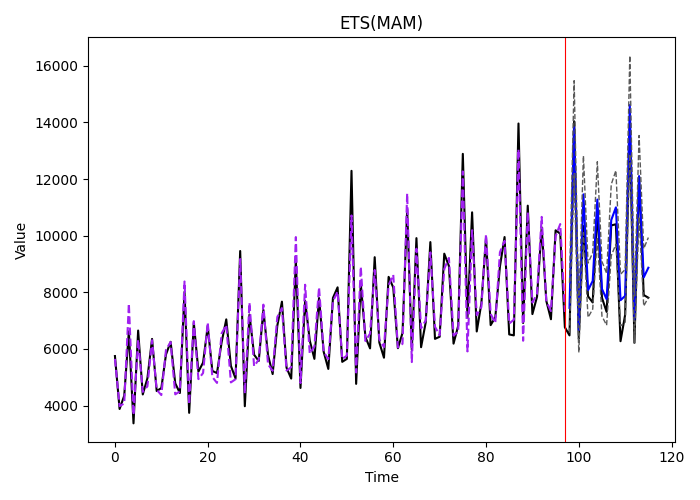
As some of you have heard, the smooth package is now on PyPI. So, I’ve decided to write a series of posts showcasing how some of its functions work. We start with the basics, ETS.
ETS stands for the “Error-Trend-Seasonal” model or ExponenTial Smoothing. It is a statistical model that relies on time series decomposition and updates the unobserved states (level/trend/seasonal) based on the mistakes it makes. In a way, you can call it an adaptive model that changes its forecast based on the most recent available information. It is relatively simple to explain and work with, and it has performed well in a variety of competitions (M3, M4, M5, for example).
The smooth package implements an advanced form of ETS in the ADAM and a more basic one in the ES classes. In fact, ES is just a wrapper of ADAM, it is the conventional model, with just some tuning. Both support all 30 ETS models, have automated model selection and forecast combination, allow producing point forecasts and a variety of prediction intervals types. In fact, if you want a straightforward robust implementation of ETS, give ES a try.
Here’s how to use it in Python:
from smooth import ES
from fcompdata import M3

# Pick a series from the M3 competition for demonstration
series = M3[2568]
y = series.x
freq = series.period

# Fit ES with the automatic model selection
model = ES(lags=freq, h=18, holdout=True)
model.fit(y)
print(model)
Running this produces output similar to this:
Time elapsed: 0.4 seconds
Model estimated using ES() function: ETS(MAM)
With backcasting initialisation
Distribution assumed in the model: Normal
Loss function type: likelihood; Loss function value: 724.8524
Persistence vector g:
 alpha   beta  gamma
0.0065 0.0000 0.0000
Sample size: 98
Number of estimated parameters: 4
Number of degrees of freedom: 94
Information criteria:
      AIC      AICc       BIC      BICc
1457.7047 1458.1348 1468.0446 1469.0306

Forecast errors:
ME: -580.9985; MAE: 604.0204; RMSE: 710.5457
sCE: -149.9347%; Asymmetry: -2.5%; sMAE: 8.6598%; sMSE: 1.0378%
MASE: 0.2653; RMSSE: 0.2452; rMAE: 0.2555; rRMSE: 0.2163
A few things worth noting from the output:
- ES automatically selected ETS(MAM) based on the AICc value – a multiplicative error, additive trend, multiplicative seasonality model – as the best fit
- It used backcasting for the model initialisation (default), which speeds up the process and requires fewer parameters to estimate
- It kept the last 18 observation for the holdout, produced autoforecasts for it and calculated several forecast errors. This is handy if you want to directly compare different smooth models on a time series.
But why are we here? We want to forecast! So, here it is:
model.predict(h=18, interval="prediction")
model.plot(7)
This should produce an image similar to the one attached to the post. As simple as that.
Now it’s your turn! :)
🔗 Install smooth: pip install smooth
📖 smooth wiki