
Here is a curious idea: if we can somehow estimate the importance of trend/seasonal components for your data, you can use this in model building and forecasting. But how can we do this first step? Hans Levenbach has an answer with his simple EDA technique. Let me explain.
The core idea is simple and neat. For this example, I’ll use monthly data, like the time series in this image:
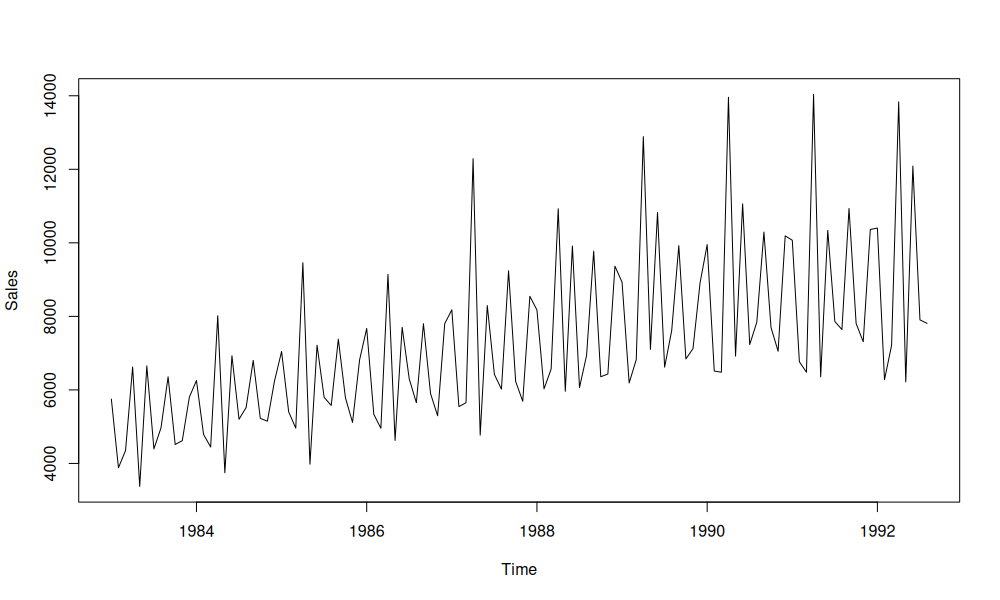
You can see that the data has strong seasonality, and we can qualitatively say that capturing that seasonal component correctly will probably solve the main problem in capturing the structure. But how can we quantify this?
All you need to do is put the data in a “wide” format, with months in rows and years in columns. Then, as Hans proposed, run a two-way ANOVA with “month” and “year” to capture variability due to year (trend) and due to month (seasonality). Roughly, we take row/column means to get mean seasonal profiles and mean annual changes (trend), as in the following two images:
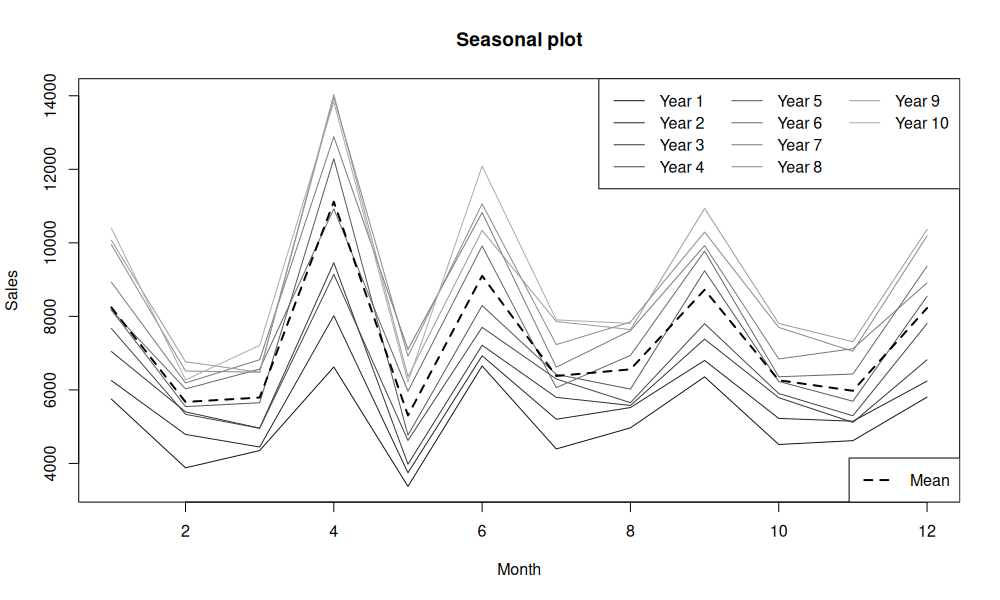
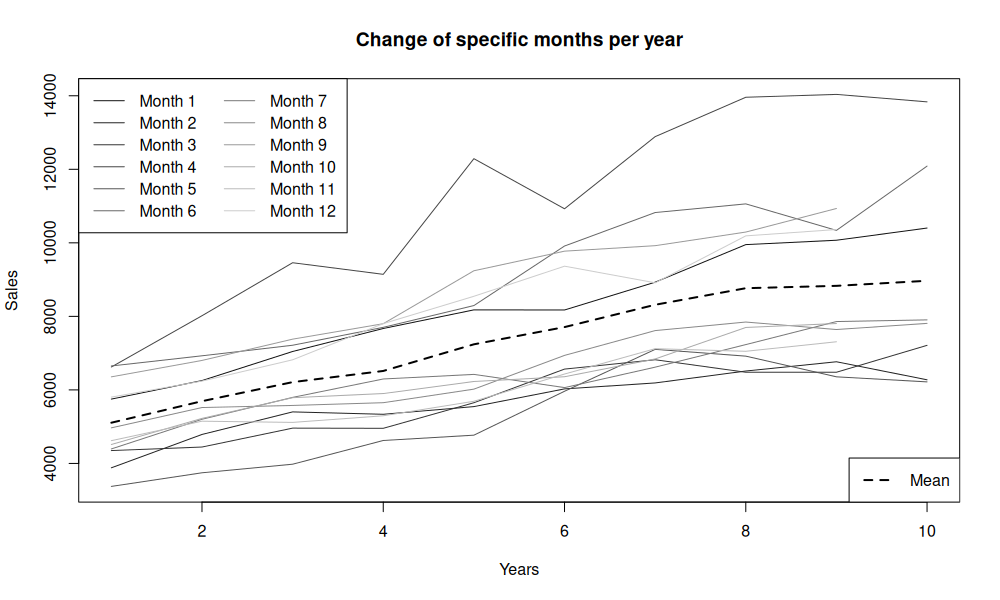
The former has no trend, the latter has no seasonality, so they can be analysed separately. Then we calculate the sums of squares of these means from the global mean to estimate variation due to months (seasonality) and years (trend). We can also calculate the sum of squares of the irregular component (what is left), giving three elements that add up to the total sum of squares.
Next step is trivial and straightforward: calculate the shares of each component in the total sum of squares. For our example, using aov() in R and then computing the total:
Seasonal:  292,307,558
Trend:     176,308,365
Irregular:  33,618,630

Total:     502,234,552
So, the seasonal contribution is 292,307,558 / 502,234,552 ≈ 58.2%, the trend contribution is 35.1%, and the irregular component is 6.69%.
Why bother? This simple EDA technique tells you roughly what to focus in forecasting. In this example, capturing seasonality correctly is roughly 60% of the story, with trend being second in importance. Hans goes further in his derivations, see his LinkedIn post. He also analysed M3 results at some point, explaining why some methods performed better (trend dominated the data).
It is worth pointing out that this approach assumes that the seasonal component does not evolve over time, which is reasonable but not always correct. And the model behind this is essentially a regression with dummy variables for year and month. Nonetheless, it is a great starting point for EDA.
P.S. Hans Levenbach passed away on 7 April 2026. I wasn’t sure whether to write about it and what to write about him, but I had several nice discussions with him, and I have admired his approach to forecasting: first explore the data, then build a model. His passing is a loss for the forecasting community.
P.P.S. You can read a bit about him on the IIF website.
CMAF had a webinar with Hans a couple of years ago. We had technical issues, but he managed to explain his idea well.