smooth in python: multiple seasonal ETS

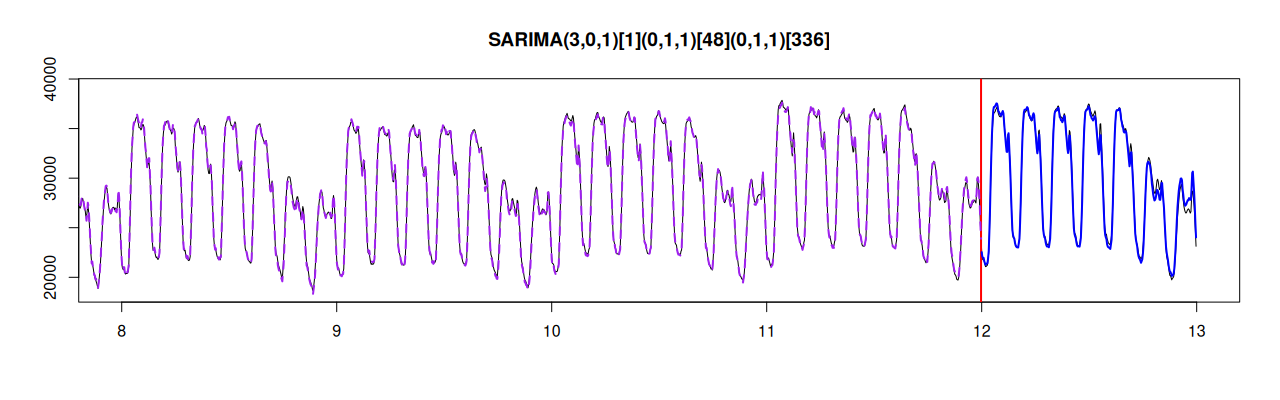
Another interesting case in demand forecasting is the high frequency data. For example, if you work with demand on daily level, you might notice that demand increases every Monday but also exhibits proper seasonal fluctuations (e.g. decline every Winter). What do you do in this case? One of the solutions (old but gold) is the […]

smooth in python: ETS forecast combination

Last time we saw how to do automated model selection using the ES function from the smooth package. Now I want to show how to produce combined forecasts from ETS. Why bother? There is a vast body of literature on forecast combinations (read this great review). The main idea is that you should not put […]

smooth in python: ETS with model selection

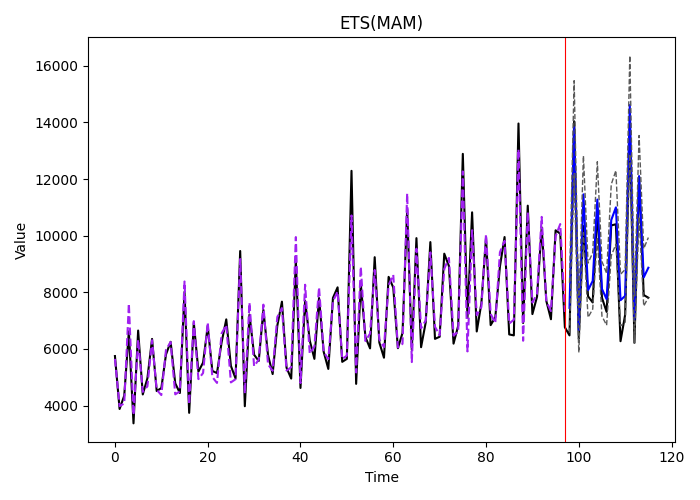
As some of you have heard, the smooth package is now on PyPI. So, I’ve decided to write a series of posts showcasing how some of its functions work. We start with the basics, ETS. ETS stands for the “Error-Trend-Seasonal” model or ExponenTial Smoothing. It is a statistical model that relies on time series decomposition […]

Fundamental Flaw of the Box-Jenkins Methodology

If you have taken a course on forecasting or time series analysis, you’ve probably heard of ARIMA and the Box–Jenkins methodology. In my opinion, this methodology has a fundamental flaw and should not be used in practice. Here’s why. When Box and Jenkins wrote their book back in the 1960s, it was a very different […]

Why is it hard to beat the Simple Moving Average?

Simple Moving Average (SMA) is one of the basic forecasting methods. It doesn’t rely on time series decomposition, doesn’t have a seasonal component, and doesn’t include explanatory variables. Yet, in a supply chain context, SMA is sometimes a tough benchmark to beat. Why? First things first, SMA is simply the arithmetic mean of several recent […]

Multistep loss functions: Geometric Trace MSE

While there is a lot to say about multistep losses, I’ve decided to write the final post on one of them and leave the topic alone for a while. Here it goes. Last time, we discussed MSEh and TMSE, and I mentioned that both of them impose shrinkage and have some advantages and disadvantages. One […]

Multistep loss functions: Trace MSE

As we discussed last time, there are two possible strategies in forecasting: recursive and direct. The latter aligns with the estimation of a model using a so-called multistep loss function, such as Mean Squared Error for h-steps-ahead forecast (MSEh). But this is not the only loss function that can be efficiently used for model estimation. […]

Recursive vs Direct Forecasting Strategy

Have you heard about the recursive vs direct forecasts? There’s literature about them in the areas of both ML and statistics. What’s so special about them? Here is a short post. The term “recursive” forecasting refers to the approach, when we produce one-step-ahead forecast first, then use it to produce two-steps-ahead, three-steps-ahead, and so on. […]