
smooth forecasting with the smooth package in Python

Here is another piece of news I have been hoping to deliver for quite some time now (since January 2026 actually). We have finally created the first release of the smooth package for Python and it is available on PyPI! Anyone interested? Read more! On this page: Why does “smooth” exist? A bit of history … Read more

Fundamental Flaw of the Box-Jenkins Methodology

Sarah by Yegor Kamelev

If you have taken a course on forecasting or time series analysis, you’ve probably heard of ARIMA and the Box–Jenkins methodology. In my opinion, this methodology has a fundamental flaw and should not be used in practice. Here’s why. When Box and Jenkins wrote their book back in the 1960s, it was a very different … Read more

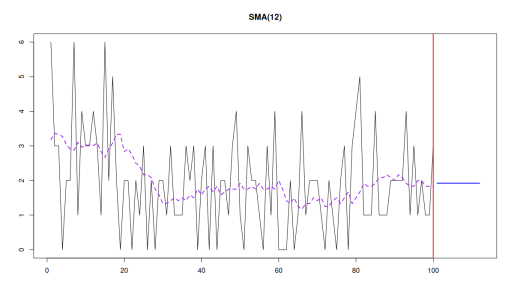
Why is it hard to beat the Simple Moving Average?

Intermittent demand and a forecast

Simple Moving Average (SMA) is one of the basic forecasting methods. It doesn’t rely on time series decomposition, doesn’t have a seasonal component, and doesn’t include explanatory variables. Yet, in a supply chain context, SMA is sometimes a tough benchmark to beat. Why? First things first, SMA is simply the arithmetic mean of several recent … Read more

Multistep loss functions: Geometric Trace MSE

While there is a lot to say about multistep losses, I’ve decided to write the final post on one of them and leave the topic alone for a while. Here it goes. Last time, we discussed MSEh and TMSE, and I mentioned that both of them impose shrinkage and have some advantages and disadvantages. One … Read more

Multistep loss functions: Trace MSE

As we discussed last time, there are two possible strategies in forecasting: recursive and direct. The latter aligns with the estimation of a model using a so-called multistep loss function, such as Mean Squared Error for h-steps-ahead forecast (MSEh). But this is not the only loss function that can be efficiently used for model estimation. … Read more

Recursive vs Direct Forecasting Strategy

Have you heard about the recursive vs direct forecasts? There’s literature about them in the areas of both ML and statistics. What’s so special about them? Here is a short post. The term “recursive” forecasting refers to the approach, when we produce one-step-ahead forecast first, then use it to produce two-steps-ahead, three-steps-ahead, and so on. … Read more

Detecting patterns in white noise

Back in 2015, when I was working on my paper on Complex Exponential Smoothing, I conducted a simple simulation experiment to check how ARIMA and ETS select components/orders in time series. And I found something interesting… One of the important steps in forecasting with statistical models is identifying the existing structure. In the case of … Read more

What’s wrong with ARIMA?

Have you heard of ARIMA? It is one of the benchmark forecasting models used in different academic experiments, although it is not always popular among practitioners. But why? What’s wrong with ARIMA? ARIMA has been a standard forecasting model in statistics for ages. It gained popularity with the famous Box & Jenkins (1970) book and … Read more

Why you should not use Holt-Winters method

Whenever I see results of an experiment that include Holt-Winters method, I shrug. You should not use it, and here is why. Holt-Winters was developed in 1960 by a student of Charles Holt, Peter Winters (Winters, 1960). He extended Holt’s exponential smoothing method (the method that introduced a trend component) to include a seasonal component. … Read more

Staying Positive: Challenges and Solutions in Using Pure Multiplicative ETS Models

Authors: Ivan Svetunkov, John E. Boylan Journal: IMA Journal of Management Mathematics Abstract: Exponential smoothing in state space form (ETS) is a popular forecasting technique, widely used in research and practice. While the additive error ETS models have been well studied, the multiplicative error ones have received much less attention in forecasting literature. Still, these … Read more