SBC is not for you!

Stop using SBC!

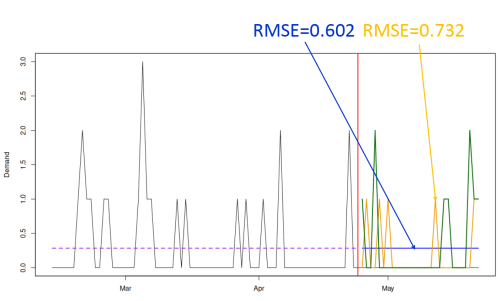
I’ve been acting as a reviewer lately, providing comments on papers about intermittent demand, and I’ve felt a bit frustrated by what some authors write. Let me explain. Several papers I reviewed claim that demand can be either intermittent or lumpy. They then mention the Syntetos-Boylan-Croston (SBC) classification and use the thresholds from Syntetos et … Read more
Svetunkov & Sroginis (2025) – Model Based Demand Classification

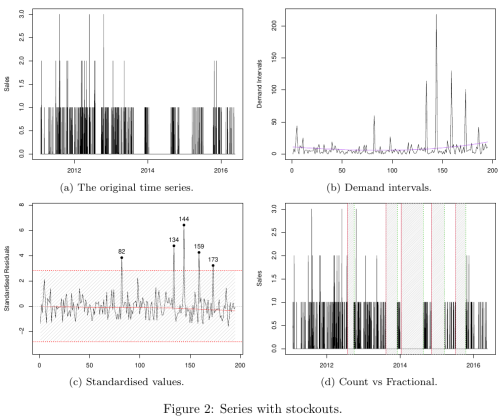
Stockouts detection algorithm, Figure 2 from the paper https://doi.org/10.48550/arXiv.2504.05894

For the last year, Anna Sroginis and I have been working on a paper, trying to modernise demand classification schemes and make them useful in the brave new era of machine learning. We have finally wrapped it up and submitted it to a peer-reviewed journal. But the temptation to share was too strong, so we … Read more

Don’t use MAE-based error measures for intermittent demand!

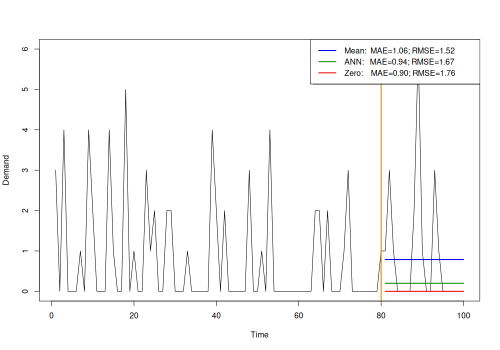
I’m currently doing a literature review for one of my papers on intermittent demand forecasting with machine learning, and I’ve noticed a recurring fundamental mistake in several recently published papers, even in respectable peer-reviewed journals. The mistake? Using error measures based on the Mean Absolute Error (MAE). This is a crime against the humanity when … Read more

Intermittent demand: don’t try to predict WHEN it will happen

I’ve seen several times ML experts applying principles of classification for intermittent demand forecasting. For example, they try predicting, WHEN the demand will happen. This is not a very sensible thing to do. The featured image in this post shows two forecasting approaches: one that tries to predict when demand happens (the yellow line), and … Read more

Why Naive is not a good benchmark for intermittent demand

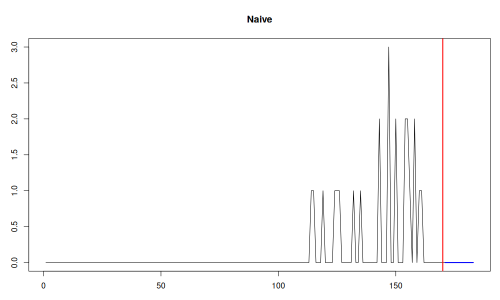
While Naive is considered a standard benchmark in forecasting, there is a case where it might not be a good one: intermittent demand. And here is why I think so. Naive is a forecasting method that uses the last available observation as a forecast for the next ones. It does not have any parameters to … Read more

Why zeroes happen

Anna Sroginis and I have been working on a new approach for intermittent demand classification over the past year. We’ve taken a fresh look at the problem, starting by asking: why do zeroes happen? Let’s discuss why indeed. First, a quick note: it’s a mistake to define intermittent demand simply as “demand with zeroes”. That … Read more

Intermittent demand classifications: is that what you need?

When you start working with your data and suddenly realise that there are zeroes there, i.e. it is intermittent demand, what should you do first? Some people use SBC classification, but is that what you need? Let’s discuss! Intermittent demand comes in different flavours: sometimes zeroes occur frequently with low demand volumes, while other times … Read more

Introduction to intermittent demand

Sometimes, when you need to forecast demand, you may notice that the recorded data contains zeroes. There are several possible reasons for this, but today we’ll briefly discuss one of them. Welcome to the world of “intermittent demand”! Intermittent demand is the demand that happens at irregular frequency (Svetunkov & Boylan, 2023). This means you … Read more

What about all those zeroes? Measuring performance of models on intermittent demand

UPDATE: Read more about intermittent demand in newer posts: Introduction to intermittent demand Do you really need SBC? Lumpy is a type of intermittent demand and the usefulness of the classification scheme; And there is more, check the Intermittent Demand category on the website. In one of the previous posts, we have discussed how to … Read more