
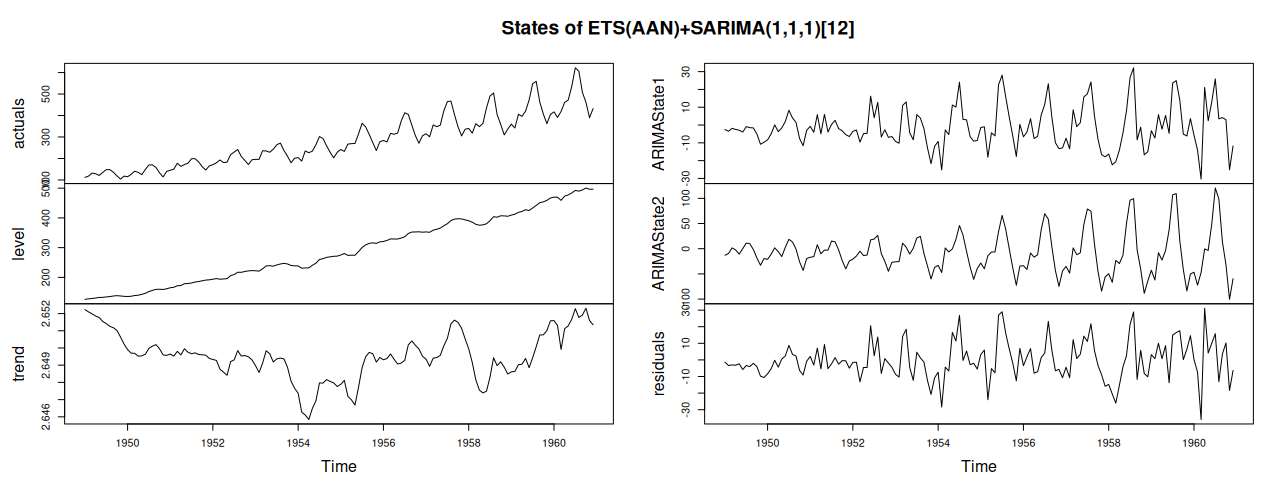
ETS is powerful. ARIMA is powerful. But when you need both, you are typically left with fitting ARMA to the residuals of ETS, which biases the parameters. There is a much neater solution: combine them in one state space model to estimate everything jointly…
The standard practice when ETS is not enough to capture the dynamics of real demand is to either switch to ARIMA or apply it to the residuals of the model. But it is possible to join the two models in one by using the Single Source of Error (SSOE) state space framework and to estimate the parameters jointly. This reduces the bias in the parameter estimates, letting the two models work as a team rather than one cleaning up after the other.
In the SSOE form, ETS and ARIMA states are stacked one after another in a large vector. For example, an ETS(A,N,A)+AR(2) model has four states: level, seasonal, and two AR components — each updated independently but responding to the same shock. Structurally, this resembles fitting ETS and then modelling its residuals with ARIMA, but with a critical difference: the parameters are estimated jointly, removing the bias that accumulates from sequential fitting.
But this flexibility comes with constraints. Some ETS and ARIMA combinations are actually redundant — they describe the same process from two angles, producing infinitely many parameter combinations with identical fit. For example, ETS(A,N,N) and ARIMA(0,1,1) are equivalent models, and combining them creates an unidentifiable model with no stable solution. So, I have come up with a few practical guidelines, which you can read about in Section 9.4 of ADAM.
Practically speaking, this is all handled under the hood of the ADAM function in Python, so you don’t need to worry about it. Here is an example:
from fcompdata import AirPassengers
from smooth import ADAM

# ETS(A,A,N) + SARIMA(0,0,0)(1,1,1)[12]
model = ADAM(
    model="AAN",
    ar_order=[0, 1],
    i_order=[0, 1],
    ma_order=[0, 1],
    lags=[1, 12],
    h=12, holdout=True
)
model.fit(AirPassengers.y)
Note how the orders are specified: per lag, with the first element referring to lag 1 and the second to lag 12. The code above fits ETS(A,A,N) + SARIMA(0,0,0)(1,1,1)[12], delegating the seasonality to the ARIMA part. The advantage of doing this via ADAM is that the result can be compared with pure ETS or ARIMA directly using information criteria. And if you don’t want to choose the orders yourself, AutoADAM will select them for you.
But do you even need the full combination? Gardner (1985) and Taylor (2010) argued that adding AR(1) tends to improve the accuracy of ETS. So, maybe you can get away with the simple ETS+AR(1) model, which is easy to apply using ADAM.
When to use ETS vs ARIMA.
How to combine them.
Try it yourself: pip install smooth