
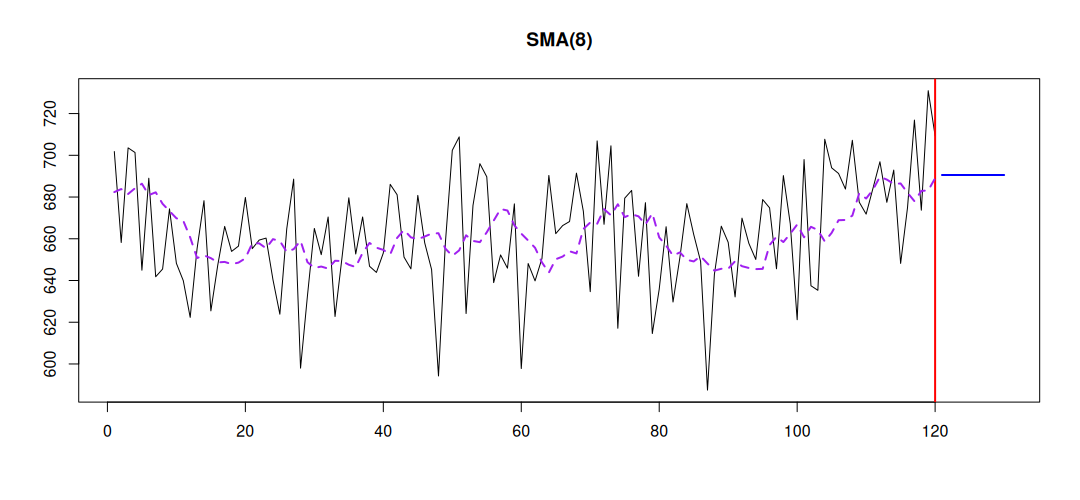
And here is another forecasting method that is hard to beat in practice. In a recent competition, it gave data scientists huge headaches and even outperformed some powerful ML methods. What’s the name of this beast?! Simple Moving Average!
The idea behind the Simple Moving Average (SMA) is to take the average of the last few observations and use it as a forecast for the next several steps ahead. Very crude and very simple. In fact, it has Naive (from this post) as a special case if you take the average of one most recent observation. On the other hand, if you increase the order to include all the observations, you will end up with the Global Mean. And this simple method works quite well if you have level data, i.e. no apparent strong trend, no obvious seasonality, and no other important elements of structure.
The only thing that makes it a bit harder to use in practice is the choice of the order, i.e. the number of observations to average over. Unfortunately, there is no universal answer here. But people report that the order of 12 or 13 is fine for weekly data, although it’s not completely clear why. In the academic literature, Aris Syntetos & John Boylan (2005) found that SMA(13) performed quite well on intermittent demand data, which was unexpected given the nature of the data (lots of zeroes). And almost 10 years ago, Fotios Petropoulos and I proposed a model underlying SMA with automatic order selection. We showed that it outperforms other simple benchmarks on supply chain data.
There is also some evidence from the VN2 inventory competition by Nicolas Vandeput. The benchmark there was built around a 13-week moving average with a simple seasonal adjustment, and only 25 out of 180+ participants managed to beat it. Many sophisticated ML pipelines lost to a method that predates computers.
So, if you work, for example, in retail or in supply chain, SMA is a method to consider for your sanity-check pool of models. But don’t expect miracles from it! It is still a simple method that works for level time series. Use it as a stepping stone to find a better model that has more features.
Anyone else found SMA to be a strong contender? Leave a comment – it would be interesting to see how many of you have had the same experience.
And yes, we discuss it in our “Demand Forecasting Principles” training in more detail. The next one will be held online in November, with live sessions from 2pm to 4pm UK time. We still have a few places left, so register here.