stick function for the EDA in time series

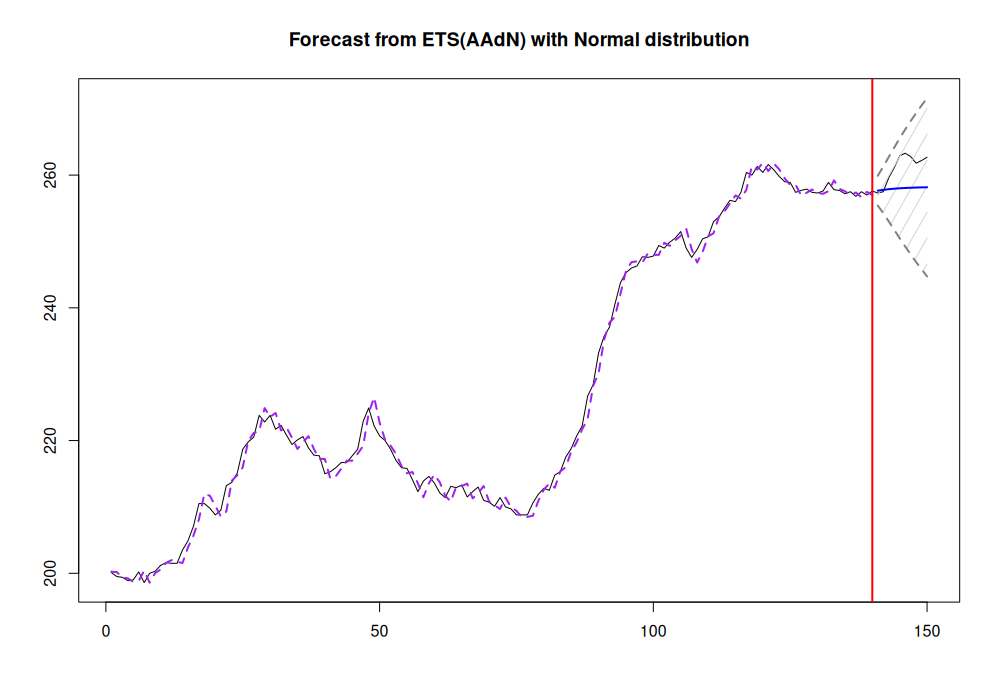
You have probably seen my post about the STI classification of Hans Levenbach (this one). Well, I’ve decided to implement it, and it has landed in the greybox package for R/Python. What’s greybox? It is a package for statistical modelling focusing on forecasting and time series analysis. I created it back in 2018 to split … Read more

Risky business: how to select your model based on risk preferences

A distribution of some error measures across models

What do you use for model selection? Do you select the best model based on its cross-validated performance, or do you use in-sample measures like AIC? If so, there is a way to improve your selection process further. JORS recently published the paper of Nikos Kourentzes and I based on a simple but powerful idea: … Read more

Review of a paper on comparison of modern machine learning techniques in retail

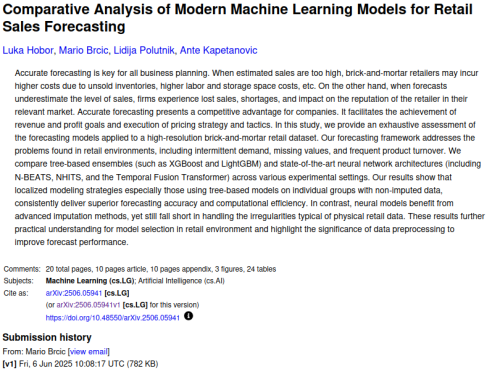
A couple of days ago, I noticed a link to the following paper in a post by Jack Rodenberg: https://arxiv.org/abs/2506.05941v1. The topic seemed interesting and relevant to my work, so I read it, only to find that the paper contains several serious flaws that compromise its findings. Let me explain. Introduction But first, why am … Read more

5th IMA and OR Society Conference

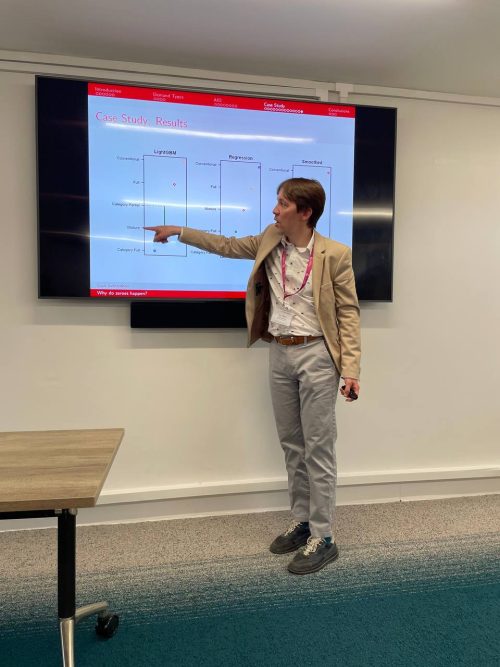
It was a pleasure to attend the 5th IMA and OR Society Conference at Aston University, Birmingham, and to present my research with Anna Sroginis on model-based demand classification. A great crowd of people from universities across the UK, along with several esteemed international colleagues. The event was very well organised – thanks to Aris … Read more

Challenges related to seasonal data: shifting seasonality

Hourly seasonal plot from the paper https://doi.org/10.1080/20476965.2023.2200526

There are many different issues with capturing seasonality in time series. In this short post, I’d like to discuss one of the most annoying ones. I’m talking about the seasonal pattern that shifts over time. What I mean is that, for example, instead of having the standard number of observations in the cycle (e.g., 24 … Read more

Methods for the smooth functions in R

Forecast from the full ADAM, containing both location and scale parts

I have been asked recently by a colleague of mine how to extract the variance from a model estimated using adam() function from the smooth package in R. The problem was that that person started reading the source code of the forecast.adam() and got lost between the lines (this happens to me as well sometimes). … Read more

The role of M competitions in forecasting

If you are interested in forecasting, you might have heard of M-competitions. They played a pivotal role in developing forecasting principles, yet also sparked controversy. In this short post, I’ll briefly explain their historical significance and discuss their main findings. Before M-competitions, only few papers properly evaluated forecasting approaches. Statisticians assumed that if a model … Read more

Story of “Probabilistic forecasting of hourly emergency department arrivals”

The paper Back in 2020, when we were all siting in the COVID lockdown, I had a call with Bahman Rostami-Tabar to discuss one of our projects. He told me that he had an hourly data of an Emergency Department from a hospital in Wales, and suggested writing a paper for a healthcare audience to … Read more

Probabilistic forecasting of hourly emergency department arrivals

Authors: Bahman Rostami-Tabar, Jethro Browell, Ivan Svetunkov Journal: Health Systems Abstract: An accurate forecast of Emergency Department (ED) arrivals by an hour of the day is critical to meet patients’ demand. It enables planners to match ED staff to the number of arrivals, redeploy staff, and reconfigure units. In this study, we develop a model … Read more