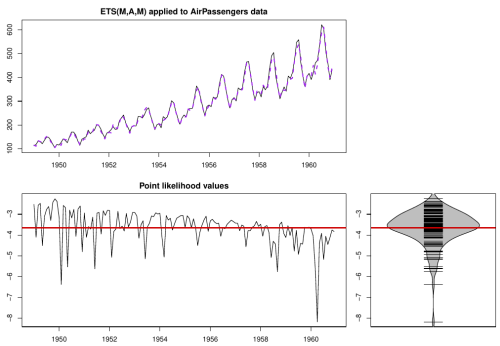
smooth in python: ETS forecast combination

Last time we saw how to do automated model selection using the ES function from the smooth package. Now I want to show how to produce combined forecasts from ETS. Why bother? There is a vast body of literature on forecast combinations (read this great review). The main idea is that you should not put … Read more
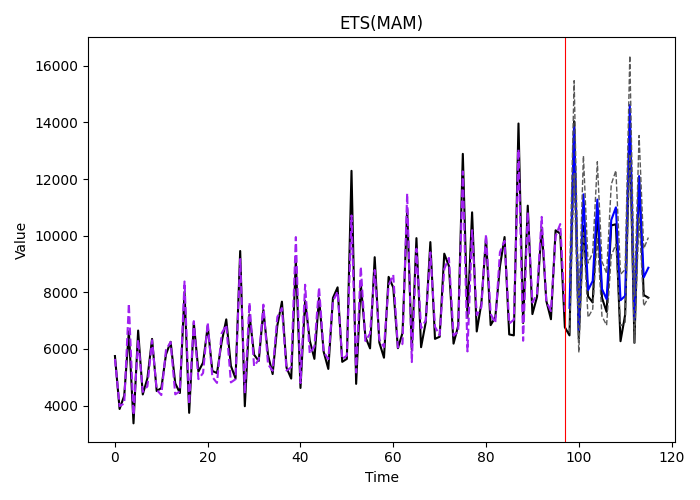

smooth in python: ETS with model selection

As some of you have heard, the smooth package is now on PyPI. So, I’ve decided to write a series of posts showcasing how some of its functions work. We start with the basics, ETS. ETS stands for the “Error-Trend-Seasonal” model or ExponenTial Smoothing. It is a statistical model that relies on time series decomposition … Read more

smooth forecasting with the smooth package in Python

Here is another piece of news I have been hoping to deliver for quite some time now (since January 2026 actually). We have finally created the first release of the smooth package for Python and it is available on PyPI! Anyone interested? Read more! On this page: Why does “smooth” exist? A bit of history … Read more

ITISE2025: Beyond summary performance metrics for forecast selection and combination

A gist of pAIC

This year, I couldn’t attend the International Symposium on Forecasting (organised by the International Institute of Forecasters), which I usually do, so instead I went to Gran Canaria for the International Conference on Time Series and Forecasting (aka ITISE). The location was fantastic, and I enjoyed several talks. I was also glad to catch up … Read more

smooth v4.3.0 in R: what’s new and what’s next?

Sticker of the smooth package for R

Good news! The smooth package v4.3.0 is now on CRAN. And there are several things worth mentioning, so I have written this post. New default initialisation mechanism Since the beginning of the package, the smooth functions supported three ways for initialising the state vector (the vector that includes level, trend, seasonal indices): optimisation, backcasting and … Read more

Multistep loss functions: Geometric Trace MSE

While there is a lot to say about multistep losses, I’ve decided to write the final post on one of them and leave the topic alone for a while. Here it goes. Last time, we discussed MSEh and TMSE, and I mentioned that both of them impose shrinkage and have some advantages and disadvantages. One … Read more

Detecting patterns in white noise

Back in 2015, when I was working on my paper on Complex Exponential Smoothing, I conducted a simple simulation experiment to check how ARIMA and ETS select components/orders in time series. And I found something interesting… One of the important steps in forecasting with statistical models is identifying the existing structure. In the case of … Read more

What does “lower error measure” really mean?

“My amazing forecasting method has a lower MASE than any other method!” You’ve probably seen claims like this on social media or in papers. But have you ever thought about what it really means? Many forecasting experiments come to applying several approaches to a dataset, calculating error measures for each method per time series and … Read more

The role of M competitions in forecasting

If you are interested in forecasting, you might have heard of M-competitions. They played a pivotal role in developing forecasting principles, yet also sparked controversy. In this short post, I’ll briefly explain their historical significance and discuss their main findings. Before M-competitions, only few papers properly evaluated forecasting approaches. Statisticians assumed that if a model … Read more