
Don’t use MAE-based error measures for intermittent demand!
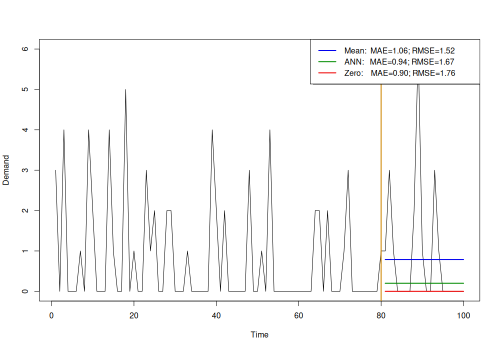
I’m currently doing a literature review for one of my papers on intermittent demand forecasting with machine learning, and I’ve noticed a recurring fundamental mistake in several recently published papers, even in respectable peer-reviewed journals. The mistake? Using error measures based on the Mean Absolute Error (MAE). This is a crime against the humanity when … Read more
Intermittent demand: don’t try to predict WHEN it will happen

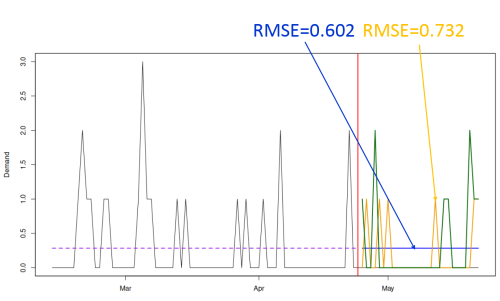
I’ve seen several times ML experts applying principles of classification for intermittent demand forecasting. For example, they try predicting, WHEN the demand will happen. This is not a very sensible thing to do. The featured image in this post shows two forecasting approaches: one that tries to predict when demand happens (the yellow line), and … Read more

Why Naive is not a good benchmark for intermittent demand

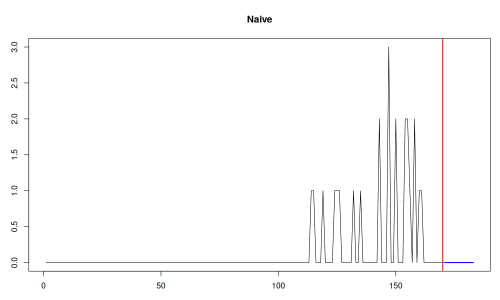
While Naive is considered a standard benchmark in forecasting, there is a case where it might not be a good one: intermittent demand. And here is why I think so. Naive is a forecasting method that uses the last available observation as a forecast for the next ones. It does not have any parameters to … Read more

Why zeroes happen

Anna Sroginis and I have been working on a new approach for intermittent demand classification over the past year. We’ve taken a fresh look at the problem, starting by asking: why do zeroes happen? Let’s discuss why indeed. First, a quick note: it’s a mistake to define intermittent demand simply as “demand with zeroes”. That … Read more

Intermittent demand classifications: is that what you need?

When you start working with your data and suddenly realise that there are zeroes there, i.e. it is intermittent demand, what should you do first? Some people use SBC classification, but is that what you need? Let’s discuss! Intermittent demand comes in different flavours: sometimes zeroes occur frequently with low demand volumes, while other times … Read more

Introduction to intermittent demand

Sometimes, when you need to forecast demand, you may notice that the recorded data contains zeroes. There are several possible reasons for this, but today we’ll briefly discuss one of them. Welcome to the world of “intermittent demand”! Intermittent demand is the demand that happens at irregular frequency (Svetunkov & Boylan, 2023). This means you … Read more

iETS: State space model for intermittent demand forecasting

Authors: Ivan Svetunkov, John E. Boylan Journal: International Journal of Production Economics Abstract: Inventory decisions relating to items that are demanded intermittently are particularly challenging. Decisions relating to termination of sales of product often rely on point estimates of the mean demand, whereas replenishment decisions depend on quantiles from interval estimates. It is in this … Read more

John E. Boylan

John Boylan and Ivan Svetunkov at ISF2022

I met John in 2014 when he joined the Department of Management Science at Lancaster University. Back then, I was in my second year of PhD, and as a teaching assistant, I helped deliver workshops for some modules. We met at the departmental Christmas party, and John asked me whether I was the very same … Read more

M-competitions, from M4 to M5: reservations and expectations

UPDATE: I have also written a short post on “The role of M competitions in forecasting“, which gives historical perspective and a brief overview of the main findings of the previous competitions. Some of you might have noticed that the guidelines for the M5 competition have finally been released. Those of you who have previously … Read more

Multiplicative State-Space Models for Intermittent Time Series, 2019

More than 2 years ago I published on this website a working paper entitled “Multiplicative State-Space Models for Intermittent Time Series“, written by John Boylan and I. This was an early version of the paper, which we submitted to International Journal of Forecasting on 31st January 2017. More than two years later (on 11th July … Read more