
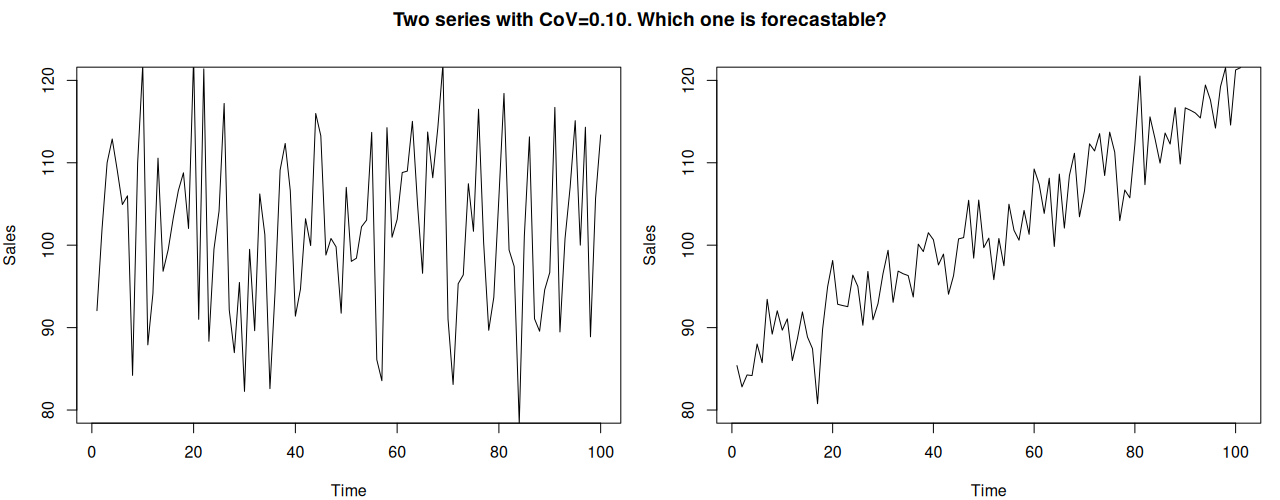
Here is a confession. I don’t like the idea of “forecastability”. I think it does not bring value and can be harmful in some cases. Let me explain.
One of the definitions I see on the internet: “A measure of the degree to which something may be forecast with accuracy”. This definition is so disturbing that I cannot resist ranting about it. The thing that annoys me the most is the “with accuracy”, which is really arbitrary and can mean anything. Your Naive method produces a relative RMSE of 1.0. Is that accurate enough? Does this make the time series forecastable? What if ETS produces 1.2, while LightGBM delivers 0.8? Is the data forecastable now? And when do you say “this is fine”?
But let me breathe and take a step back. The thing is, any method of measuring forecastability has assumptions behind it. Here is my list of five (did I miss any?):
- The models you use: each time series has its own characteristics, so you can only say that the data is “forecastable” given the set of models you have. The data with trend might look unforecastable for the model that only has the level component.
- The features/indicators that are available: if you do not know when promotions happen, some observations will look unforecastable. It’s a similar argument to (1), but more about what you include in your model. If you spend more time on feature generation and transformation, then the series that looked very hard might become quite easily forecastable.
- The statistic you focus on: this could be the conditional mean, the median, some quantile, or the whole predictive distribution. A model can do great in terms of point forecasts but very poorly when it comes to prediction intervals. Does that make the time series unforecastable? Which one do you care more about?
- The forecast horizon: the longer it is, the less accurate the forecasts become. One-step-ahead forecasts are easy, multiple steps ahead are hard. Which one do you use to measure forecastability?
- The error measures: I’ll just leave this here: https://openforecast.org/category/forecasting-theory/forecast-evaluation/
Do I hear someone mentioning the coefficient of variation (CoV) as a good measure of forecastability? This is, by the way, what is used in the conventional XYZ classification. Well, let’s check the five points above against it and see what it assumes: (1) the global mean is suitable and the variance is constant; (2) no features are available; (3) conditional mean as the statistic of interest; (4) 1-step-ahead point forecast; (5) Root Mean Squared Error (the core of the CoV). So, it is suitable for a very small set of time series. If you use it universally, you might decide that some time series with a very clear structure are not forecastable. And the same exercise works for the more sophisticated measures, entropy-based ones included: run them through the five questions and see what they silently assume.
And then we come to the final point: so what? Let’s say you split your data into the “forecastable/not” categories. What are you going to do with that? The intention behind this is legitimate — you cannot babysit ten thousand SKUs equally, so you want to know where to spend your time. But the label “unforecastable” answers the wrong question. The right question is why the series is hard to forecast: missing promotion information? Wrong model? Genuinely random demand? Each of these implies a different action. It might well be that your “unforecastable” time series just require more time and effort to become forecastable again.
We don’t teach “forecastability” in our Demand Forecasting Principles course — because, as you can see, I don’t believe in it. What we do teach is everything in the list above: models, their assumptions, features, horizons, and how to evaluate forecasts properly. See details about the next course here.
This is my personal view. Happy to hear what others have to say.