
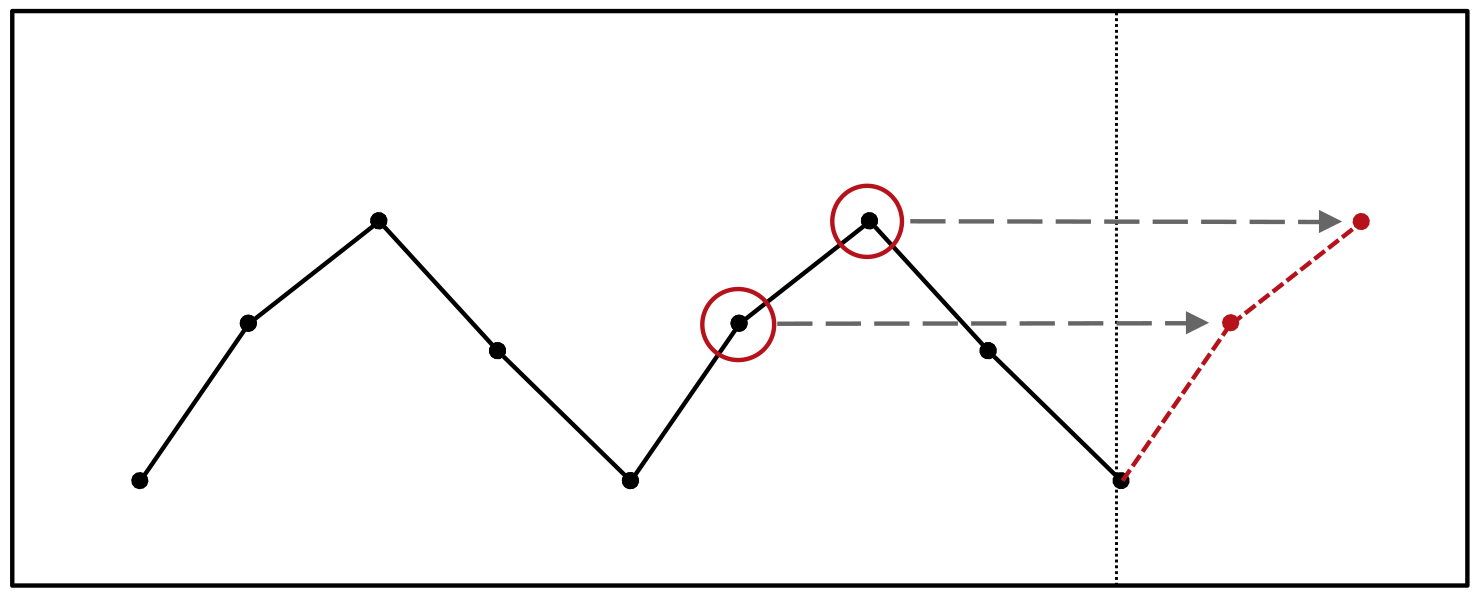
There is another forecasting method that is extremely popular, hard to beat, and has no parameters to estimate. It also has “Naïve” in its name. Do you know what I’m talking about?
It is called “Seasonal Naïve”. While the simple Naïve copies the last observed actual into the future as a forecast, the seasonal one copies the whole seasonal shape of the data and uses it as a forecast. The logic is straightforward: if you see an increase in sales every January, why not use the actual sales of January 2025 as the forecast for January 2026? Simple, easy to do, and hard to beat in some cases, especially when your demand does not have high variability.
What this method doesn’t do is filter out the noise in the data. This means that if you had a promotion-driven spike this February, Seasonal Naïve will happily copy it into next February’s forecast. So, if you have some distinct components in your time series and/or effects of explanatory variables on sales, Seasonal Naïve might not be a good choice. But it remains an essential benchmark for any seasonal data.
I actually have an anecdote related to the Seasonal Naïve. Yves Sagaert and I were working on a paper, and we decided to apply our new method to data with multiple seasonality. It worked great, better than the double seasonal exponential smoothing and ARIMA. I was really hyped and was ready to celebrate, when Yves suggested trying the Seasonal Naïve as well. It’s good that he did, because it turned out that Seasonal Naïve beat them all, including our new method, without even blinking. This was a great demonstration of a principle I had been preaching to others: if you have seasonal data, always use Seasonal Naïve as a benchmark.
In the Demand Forecasting Principles course in November, we cover simple methods like this one properly, including when to stop trusting them. Details and booking can be found here.