Structure vs. Noise: A Fundamental Concept in Forecasting

Structure vs Noise. Cloud in the shape of mushroom

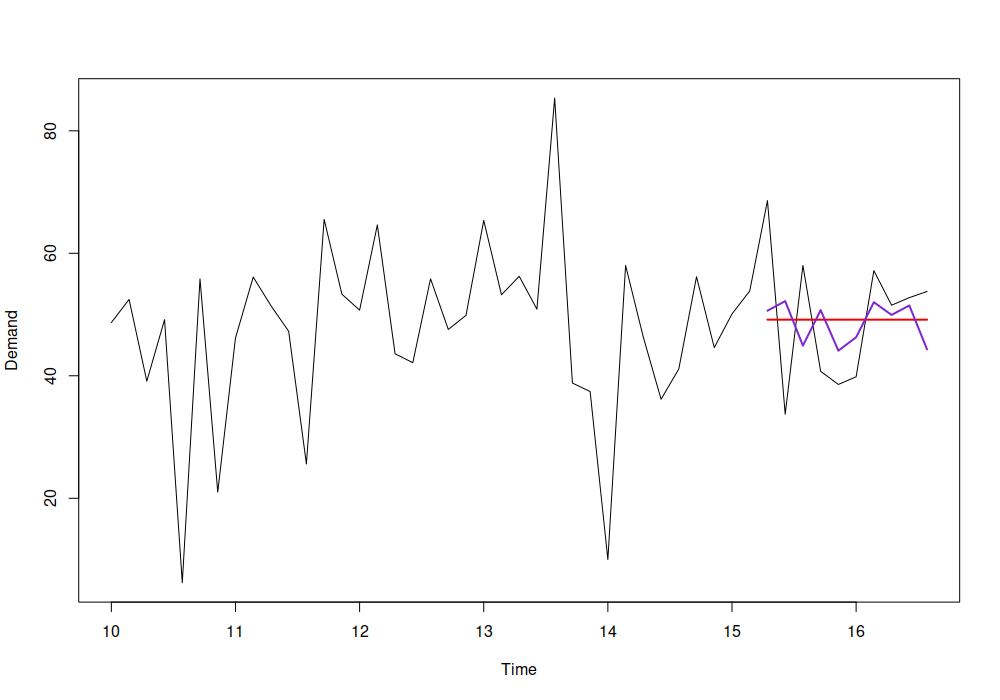
One of the core ideas in statistics, which extends to many other fields including forecasting, is the concept of structure versus noise. You’ve probably heard of it, but it’s often overlooked by those without a strong quantitative background. So, let’s discuss. The core of the idea is that any data consists of two fundamental parts: … Read more

Complex-Valued Econometrics with Examples in R

Back in 2022, my father asked me to help him in amending and editing a monograph he wrote on the topic of “Complex-Valued Econometrics”. The original book focused on dynamic models, but after looking through the material and a thorough discussion, we decided to write something more fundamental. The monograph is based on the research … Read more

Point Forecast Evaluation: State of the Art

I have summarised several posts on point forecasts evaluation in an article for the Foresight journal. Mike Gilliland, being the Editor-in-Chief of the journal, contributed to the paper a lot, making it read much smoother, but preferred not to be included as the co-author. This article was recently published in the issue 74 for Q3:2024. … Read more

Intermittent demand classifications: is that what you need?

When you start working with your data and suddenly realise that there are zeroes there, i.e. it is intermittent demand, what should you do first? Some people use SBC classification, but is that what you need? Let’s discuss! Intermittent demand comes in different flavours: sometimes zeroes occur frequently with low demand volumes, while other times … Read more

ISF2024: How to Bootstrap Time Series without Attracting Attention of Statisticians

On 1st July, I presented my ongoing work on time series bootstrap and its impact on prediction intervals at ISF2024 in Dijon, France. Abstract: Bootstrap is extensively used in statistics and machine learning for cross-sectional data to account for uncertainty about the data, model form, and parameter estimates. However, conventional methods may not be suitable … Read more

Introduction to intermittent demand

Sometimes, when you need to forecast demand, you may notice that the recorded data contains zeroes. There are several possible reasons for this, but today we’ll briefly discuss one of them. Welcome to the world of “intermittent demand”! Intermittent demand is the demand that happens at irregular frequency (Svetunkov & Boylan, 2023). This means you … Read more

Multistep loss functions: Geometric Trace MSE

While there is a lot to say about multistep losses, I’ve decided to write the final post on one of them and leave the topic alone for a while. Here it goes. Last time, we discussed MSEh and TMSE, and I mentioned that both of them impose shrinkage and have some advantages and disadvantages. One … Read more

Multistep loss functions: Trace MSE

As we discussed last time, there are two possible strategies in forecasting: recursive and direct. The latter aligns with the estimation of a model using a so-called multistep loss function, such as Mean Squared Error for h-steps-ahead forecast (MSEh). But this is not the only loss function that can be efficiently used for model estimation. … Read more

Recursive vs Direct Forecasting Strategy

Have you heard about the recursive vs direct forecasts? There’s literature about them in the areas of both ML and statistics. What’s so special about them? Here is a short post. The term “recursive” forecasting refers to the approach, when we produce one-step-ahead forecast first, then use it to produce two-steps-ahead, three-steps-ahead, and so on. … Read more

Seasonal or not?

Not every pattern that appears seasonal is genuinely seasonal. This means you don’t always require a seasonal model when you see repetitive patterns with fixed periodicity. How come? First things first, in forecasting, the term “seasonality” refers to any natural pattern repeating with some periodicity. For example, if you work in a hospital with A&E … Read more