smooth v4.3.0 in R: what’s new and what’s next?

Sticker of the smooth package for R

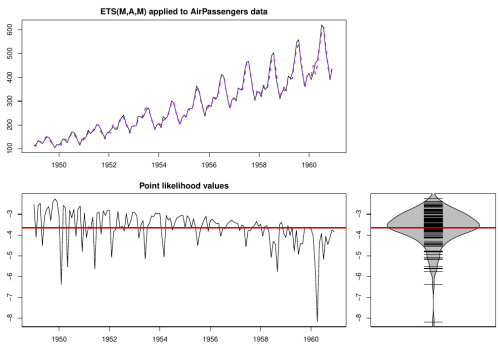
Good news! The smooth package v4.3.0 is now on CRAN. And there are several things worth mentioning, so I have written this post. New default initialisation mechanism Since the beginning of the package, the smooth functions supported three ways for initialising the state vector (the vector that includes level, trend, seasonal indices): optimisation, backcasting and … Read more

IIF Open Source Forecasting software workshop and smooth

Sticker of the smooth package for R

Here is one thing you have probably not heard of: a workshop on Open Source Forecasting software, held in Beijing on 26th – 27th June 2025. This was a closed event, with speakers attending by invitation only. It focused on recent advancements and potential avenues in open-source forecasting software. But why am I writing about … Read more

Review of a paper on comparison of modern machine learning techniques in retail

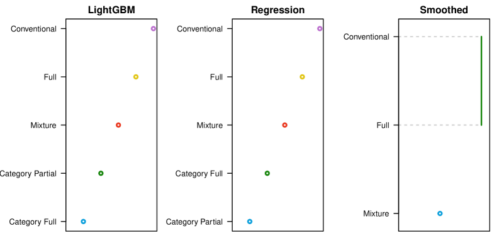
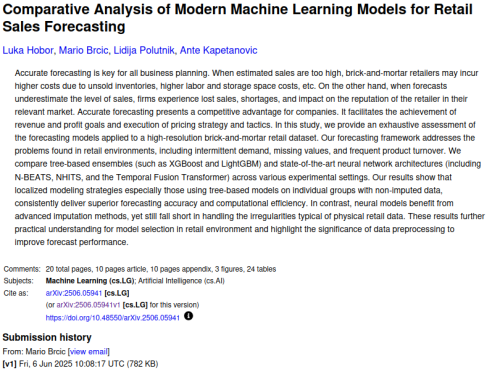
A couple of days ago, I noticed a link to the following paper in a post by Jack Rodenberg: https://arxiv.org/abs/2506.05941v1. The topic seemed interesting and relevant to my work, so I read it, only to find that the paper contains several serious flaws that compromise its findings. Let me explain. Introduction But first, why am … Read more

NATCOR course on Forecasting and Predictive Analytics, September 2025

Are there any PhD students in the crowd who want to learn more about forecasting? What about academic supervisors who have such students? Show me your hands! This post is for you! This September, we (Lancaster Centre for Marketing Analytics and Forecasting members) will deliver the Natcor course on Forecasting and Predictive Analytics at Lancaster … Read more

Online Detection of Forecast Model Inadequacies Using Forecast Errors

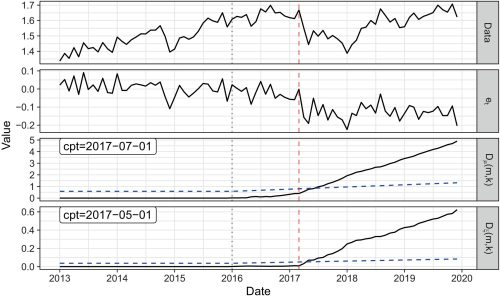
Figure 6 from the paper, showing the proportion of GRP A&E admissions, the forecast errors and two detectors.

There’s a large and fascinating area in time series analysis called “changepoint detection”. I hadn’t worked in this area before, but thanks to Rebecca Killick and Thomas Grundy, I contributed to the paper “Online Detection of Forecast Model Inadequacies Using Forecast Errors“, which has just been published in the Journal of Time Series Analysis. DISCLAIMER: … Read more

SBC is not for you!

Stop using SBC!

I’ve been acting as a reviewer lately, providing comments on papers about intermittent demand, and I’ve felt a bit frustrated by what some authors write. Let me explain. Several papers I reviewed claim that demand can be either intermittent or lumpy. They then mention the Syntetos-Boylan-Croston (SBC) classification and use the thresholds from Syntetos et … Read more

Fundamental Flaw of the Box-Jenkins Methodology

Sarah by Yegor Kamelev

If you have taken a course on forecasting or time series analysis, you’ve probably heard of ARIMA and the Box–Jenkins methodology. In my opinion, this methodology has a fundamental flaw and should not be used in practice. Here’s why. When Box and Jenkins wrote their book back in the 1960s, it was a very different … Read more

5th IMA and OR Society Conference

It was a pleasure to attend the 5th IMA and OR Society Conference at Aston University, Birmingham, and to present my research with Anna Sroginis on model-based demand classification. A great crowd of people from universities across the UK, along with several esteemed international colleagues. The event was very well organised – thanks to Aris … Read more

On randomness and uncertainty

A weather forecaster rolling a dice

Everything is random! Your data, your model, its parameter estimates, the forecasts it produces, and even the minimum of the loss function you used. There is no such thing as a “deterministic” forecast – everything is stochastic! Whenever you work with data, you are working with a sample from a population. In some cases, this … Read more