What about the training/test sets?

Train on a test site... maybe

Another question my students sometimes ask is how to define the sizes for the training and test sets in a forecasting experiment. If you’ve done data mining or machine learning, you’re likely familiar with this concept. But when it comes to forecasting, there are a few nuances. Let’s discuss. First and foremost, in forecasting, the … Read more

How to choose forecast horizon?

One of the questions my students sometimes ask is how to set the forecast horizon. The answer depends largely on the task at hand, but there are still some guidelines. First, the forecast horizon depends on data granularity. A “year ahead” forecast on monthly data means forecasting 12 steps ahead, while for daily data, it … Read more

Straight line is just fine

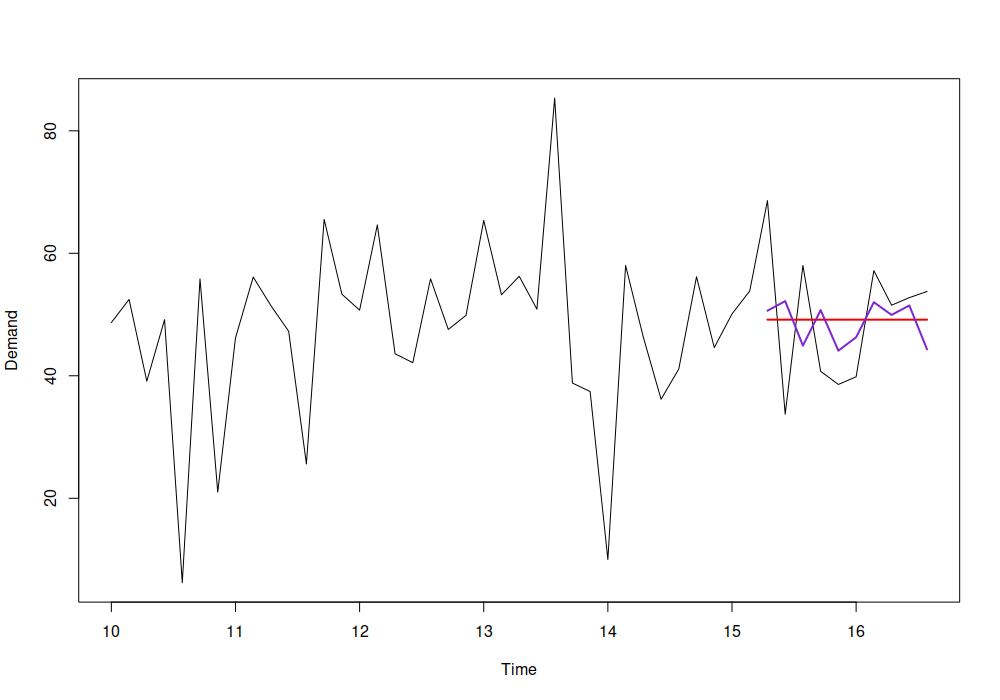
Two forecasts for some data

Look at the image above. Which forecast seems more appropriate: the red straight line (1) or the purple wavy line (2)? Many demand planners might choose option 2, thinking it better captures the ups and downs. But, in many cases, the straight line is just fine. Here’s why. In a previous post on Structure vs. … Read more

Are all forecasts wrong?

You’ve probably heard the phrase “all forecasts are wrong”, suggesting that the future is unpredictable and that no forecast will ever match the actual outcome. Well, this phrase is not entirely correct, and here’s why. When your favourite forecasting approach generates point forecasts, it usually provides a conditional mean. This means it’s giving you the … Read more

Structure vs. Noise: A Fundamental Concept in Forecasting

Structure vs Noise. Cloud in the shape of mushroom

One of the core ideas in statistics, which extends to many other fields including forecasting, is the concept of structure versus noise. You’ve probably heard of it, but it’s often overlooked by those without a strong quantitative background. So, let’s discuss. The core of the idea is that any data consists of two fundamental parts: … Read more

Point Forecast Evaluation: State of the Art

I have summarised several posts on point forecasts evaluation in an article for the Foresight journal. Mike Gilliland, being the Editor-in-Chief of the journal, contributed to the paper a lot, making it read much smoother, but preferred not to be included as the co-author. This article was recently published in the issue 74 for Q3:2024. … Read more

Intermittent demand classifications: is that what you need?

When you start working with your data and suddenly realise that there are zeroes there, i.e. it is intermittent demand, what should you do first? Some people use SBC classification, but is that what you need? Let’s discuss! Intermittent demand comes in different flavours: sometimes zeroes occur frequently with low demand volumes, while other times … Read more

Introduction to intermittent demand

Sometimes, when you need to forecast demand, you may notice that the recorded data contains zeroes. There are several possible reasons for this, but today we’ll briefly discuss one of them. Welcome to the world of “intermittent demand”! Intermittent demand is the demand that happens at irregular frequency (Svetunkov & Boylan, 2023). This means you … Read more

Multistep loss functions: Geometric Trace MSE

While there is a lot to say about multistep losses, I’ve decided to write the final post on one of them and leave the topic alone for a while. Here it goes. Last time, we discussed MSEh and TMSE, and I mentioned that both of them impose shrinkage and have some advantages and disadvantages. One … Read more