Fundamental Flaw of the Box-Jenkins Methodology

Sarah by Yegor Kamelev

If you have taken a course on forecasting or time series analysis, you’ve probably heard of ARIMA and the Box–Jenkins methodology. In my opinion, this methodology has a fundamental flaw and should not be used in practice. Here’s why. When Box and Jenkins wrote their book back in the 1960s, it was a very different … Read more

Svetunkov & Sroginis (2025) – Model Based Demand Classification

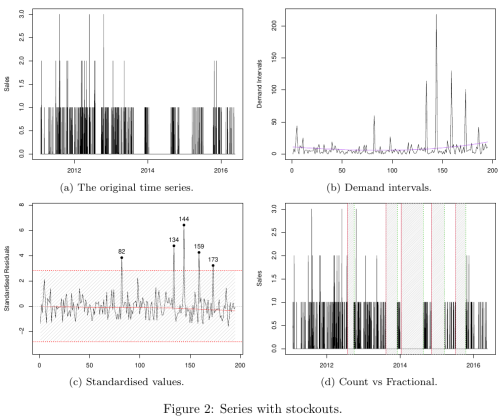
Stockouts detection algorithm, Figure 2 from the paper https://doi.org/10.48550/arXiv.2504.05894

For the last year, Anna Sroginis and I have been working on a paper, trying to modernise demand classification schemes and make them useful in the brave new era of machine learning. We have finally wrapped it up and submitted it to a peer-reviewed journal. But the temptation to share was too strong, so we … Read more

A paper to read over the Xmas holiday: Wang et al. (2023) – Forecast combinations: An over 50-year review

Christmas and the New Year are upon us, and I wanted to publish a celebratory post before taking a break. Instead of writing something educational, I decided to simply recommend a paper for you to read over the holidays – something you might have overlooked in the past couple of years. Here it is or … Read more

Intermittent demand: don’t try to predict WHEN it will happen

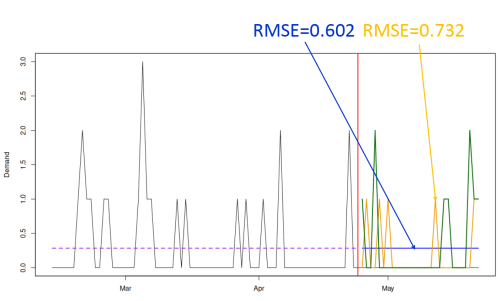
I’ve seen several times ML experts applying principles of classification for intermittent demand forecasting. For example, they try predicting, WHEN the demand will happen. This is not a very sensible thing to do. The featured image in this post shows two forecasting approaches: one that tries to predict when demand happens (the yellow line), and … Read more

Why Naive is not a good benchmark for intermittent demand

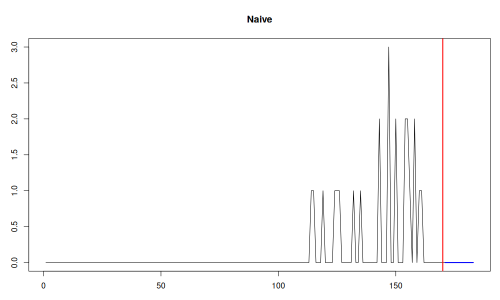
While Naive is considered a standard benchmark in forecasting, there is a case where it might not be a good one: intermittent demand. And here is why I think so. Naive is a forecasting method that uses the last available observation as a forecast for the next ones. It does not have any parameters to … Read more

Why is it hard to beat the Simple Moving Average?

Intermittent demand and a forecast

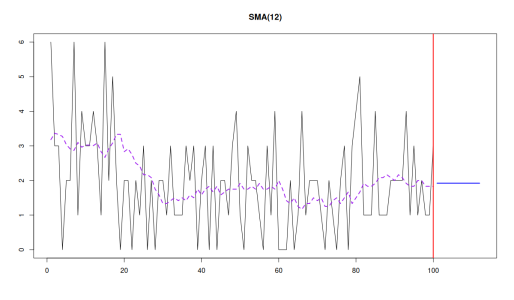
Simple Moving Average (SMA) is one of the basic forecasting methods. It doesn’t rely on time series decomposition, doesn’t have a seasonal component, and doesn’t include explanatory variables. Yet, in a supply chain context, SMA is sometimes a tough benchmark to beat. Why? First things first, SMA is simply the arithmetic mean of several recent … Read more

What about the training/test sets?

Train on a test site... maybe

Another question my students sometimes ask is how to define the sizes for the training and test sets in a forecasting experiment. If you’ve done data mining or machine learning, you’re likely familiar with this concept. But when it comes to forecasting, there are a few nuances. Let’s discuss. First and foremost, in forecasting, the … Read more

How to choose forecast horizon?

One of the questions my students sometimes ask is how to set the forecast horizon. The answer depends largely on the task at hand, but there are still some guidelines. First, the forecast horizon depends on data granularity. A “year ahead” forecast on monthly data means forecasting 12 steps ahead, while for daily data, it … Read more

Straight line is just fine

Two forecasts for some data

Look at the image above. Which forecast seems more appropriate: the red straight line (1) or the purple wavy line (2)? Many demand planners might choose option 2, thinking it better captures the ups and downs. But, in many cases, the straight line is just fine. Here’s why. In a previous post on Structure vs. … Read more

Are all forecasts wrong?

You’ve probably heard the phrase “all forecasts are wrong”, suggesting that the future is unpredictable and that no forecast will ever match the actual outcome. Well, this phrase is not entirely correct, and here’s why. When your favourite forecasting approach generates point forecasts, it usually provides a conditional mean. This means it’s giving you the … Read more